ARTICLES · M2 NEXTGEN FITNESS PROFESSIONAL
If You Train Everybody, Who Are You Building For?
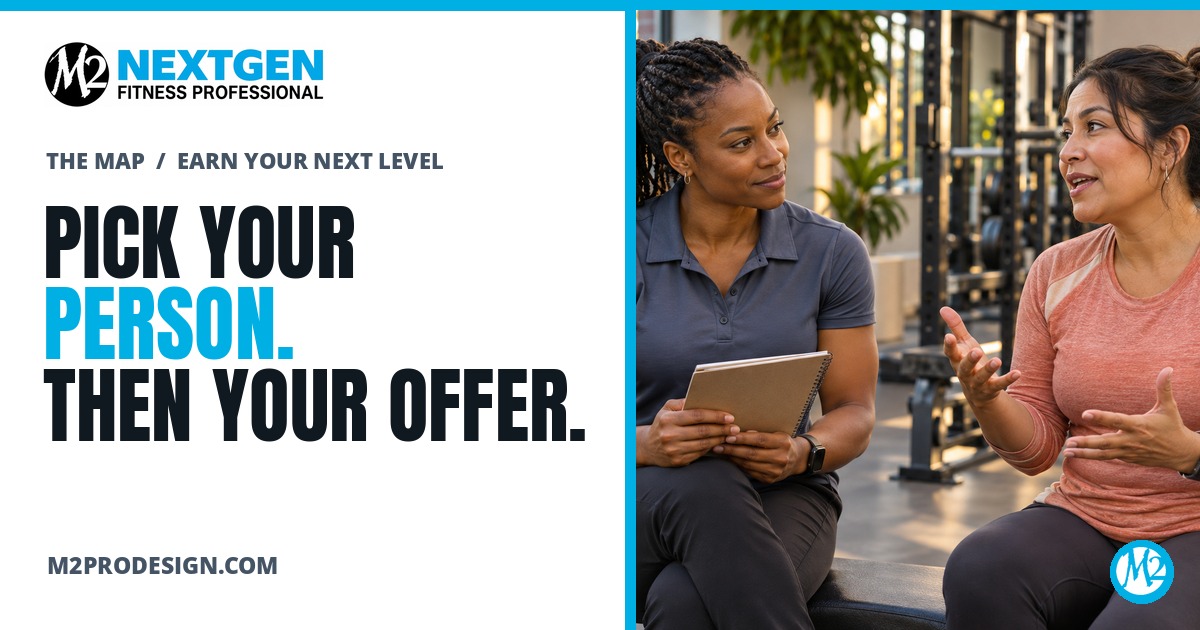
A young trainer asks me what comes next. One-on-one? Semi-private? A boot camp? Online coaching? Their own place?
I want to hear one thing first: Who are you building for?
If your answer is “anybody who wants to get fit,” I still don't know what problem you're solving. I don't know where you'll find those people or what would make them come back next week. You don't need a prettier package to answer those questions. You need to listen to somebody who might actually use it.
I've been coaching for nearly 40 years. I've worked in one-on-one coaching and group training. Each format taught me something different. You don't have to copy it, and you don't need to own a gym to have a serious coaching practice. What you need is a reason for the format you choose.
Pick one person you can coach well
Start with a person you understand and can serve within your training and scope. Give them a goal and a real constraint.
“Busy people who want to get fit” gives you very little to work with. Try this: “Adults new to strength training who work rotating shifts and can't commit to the same hour every week.”
Now you have real decisions to make. Could they use consistent appointment slots? Would they want someone beside them for their first sessions? Would a short, guided start work better than a large class? You don't know yet. That's what the next step is for.
Get clear on fit, too. If someone needs injury rehabilitation or clinical nutrition care that you aren't qualified to provide, recognize it and refer them. Knowing when to say “this isn't my lane” is part of the job.
Have three conversations before you write the offer
Talk to three people who fit the description. Tell them you're learning what gets in the way of training; don't turn the conversation into a pitch. Try these questions:
- What makes training hard to stick with?
- What have you already tried?
- What would make it easier to show up?
Ask for a specific example: “Walk me through the last time that happened.”
Write down a short, anonymous phrase from each conversation. Put what you heard in one column and what you think it means in another. If someone says, “I don't get my schedule until Friday,” don't turn it into “this person lacks discipline.” It might be a scheduling problem. Show them one workable option and find out.
Three conversations won't prove demand. They can save you from spending your next month building around the wrong assumption.
Write the sentence and pick a test
I help [specific person] work toward [meaningful goal] through [an approach that fits their life].
For the rotating-shift example: “I help adults new to lifting build a strength routine around rotating shifts through one-on-one instruction and a weekly plan they can move around.”
That's a draft, not a permanent niche. Show it to somebody it describes. Ask them what they'd expect in the first week, then listen. If their answer and yours don't match, go back and fix the offer. Give the test a date so it doesn't end up in a notes app for six months.
Use AI as a second set of eyes. Give it the draft sentence and your anonymized notes. Ask it to flag assumptions, point out vague language and write one neutral follow-up question. Then go talk to a person. AI can help you think through the next rep; you still have to take it.
Picking a person is one part of the M2 NextGen MAP. If you already know your audience but the business keeps leaking between inquiry, follow-up and onboarding, read Stop Collecting Ideas. Build the Framework..
Here's the assignment: Pick one person today. Have three conversations this week. Bring back one thing you learned, one assumption you changed and one offer you can test. That's work a mentor can look at with you.